
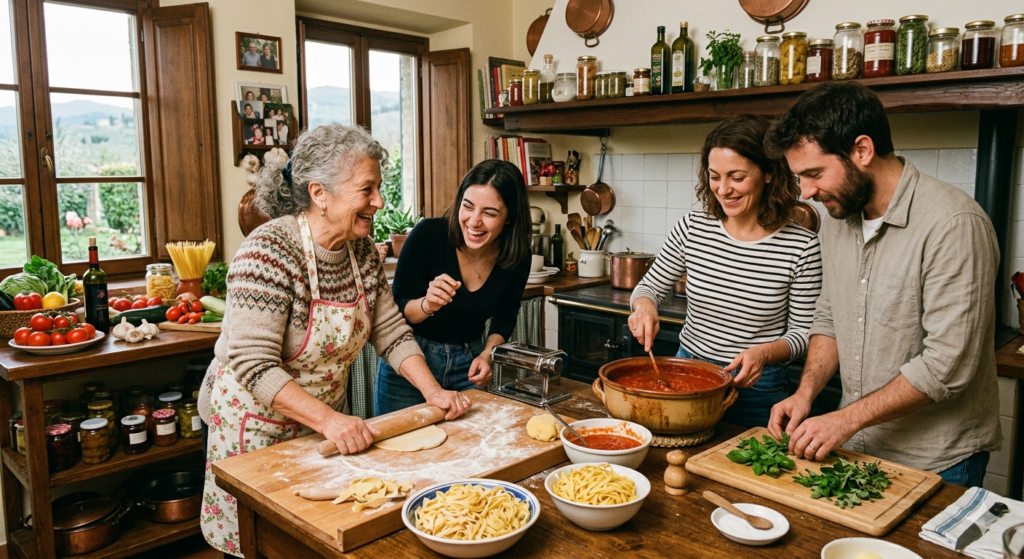
Nonnamaxxing is a TikTok trend in which people, mostly in their twenties, adopt the daily habits of an Italian grandmother (a “nonna”).
That means cooking from scratch, eating with other people, walking instead of scrolling, gardening, going to bed at a reasonable hour, and generally rejecting hustle culture in favour of a slower, more grounded way of living.
The trend has spread fast. Italy is one of the longest-lived countries in the world. Sardinia is one of the five “Blue Zones” where people routinely live past 100. At the same time, the World Health Organisation reports that around 1 in 6 people worldwide are affected by loneliness, with 17 to 21 per cent of 13 to 29-year-olds reporting feeling lonely, the highest rate of any age group. The generation inventing nonnamaxxing is also the loneliest one we have ever measured.
So it makes sense that they are reaching for tomato plants, pasta-rolling and a community focused way of life. What does not make sense is the way it is being packaged.
This is a friendly explainer with a slightly raised eyebrow.
Where did nonnamaxxing come from?
The word combines “nonna,” Italian for grandmother, with the suffix “maxxing.” It started circulating on TikTok in early 2026 and was picked up quickly by lifestyle publications, with creators sharing clips of themselves cooking, cleaning, gardening, hosting dinners, and romanticising small domestic rituals.
The actual lifestyle it describes is, of course, much older. Italian grandmothers have been cooking from scratch and eating with their families for centuries. What is new is the branding.
What does “maxxing” mean?
“Maxxing” means optimising one thing to the extreme. It started in gaming, where “min-maxing” referred to maximising your character’s stats. In the early 2010s, the suffix was picked up by online incel forums, most famously in the word “looksmaxxing,” which described men trying to maximise their physical attractiveness to improve their standing with women.
From there, “-maxxing” went mainstream on TikTok. Today we have sleepmaxxing, gymmaxxing, demuremaxxing, and now nonnamaxxing.
Which is, when you think about it, a strange contradiction. The suffix means optimisation. Nonnamaxxing is supposedly about slowing down. You cannot maximise being relaxed. The moment rest becomes a target, it stops being rest.
There is something revealing about a generation that can only give itself permission to slow down if the slowing-down is reframed as a productivity hack.
Is nonnamaxxing actually good for you?
The principles, taken on their own, are excellent and well-supported by research.
Social connection is one of the strongest predictors of physical and mental health. Loneliness has been associated with a 26 per cent higher mortality risk in older adults, an effect put on a par with smoking. Cooking from scratch is generally better for you than ultra-processed food. Daily walking improves cardiovascular health and mood. Gardening has been linked to lower rates of dementia, partly because of the cognitive effort involved in planning, remembering and monitoring change over time.
None of this is in dispute. If nonnamaxxing gets a generation away from their phones and into their kitchens, that is a genuinely good thing.
The problem is not the lifestyle. The problem is everything around it.
What’s the problem with nonnamaxxing?
We think there are three main problems.
It assumes a lot. “Cook from scratch, grow your own tomatoes, see your friends, get to bed early” sounds gentle until you list what it requires: time, money for good ingredients, a kitchen, a garden or a decent flat, friends with similar schedules, and a job that does not bleed into your evenings. For anyone working long hours, caring for children or parents, or stretched financially, nonnamaxxing is not a lifestyle choice. It is a lifestyle luxury. Sold as a personal wellness decision, it quietly suggests that a fast, frantic life is a wellness failing rather than, you know, an economy.
The aesthetic is tradwife-adjacent. “Woman retreats into the home, cooks, nurtures, opts out of paid work” is not new. It is a very specific image of female value that has been sold to women for a long time, and at its harder edges it shades into tradwife content that explicitly tells women their place is in the home. Nonnamaxxing is not the same thing. But it has a lot of cross over themes, and it is worth noticing before you screenshot the apron.
The grandmother gets erased. There is something uncomfortable about a trend that takes an entire generation of women’s unpaid labour, gives it a hashtag, and offers it back to younger women as an “aesthetic.” The real nonna who cooked for forty years without recognition is invisible in the trend that bears her name. She did not have a Bluetooth speaker. She was not filming it. She might, given the chance, have liked to be a lawyer.
Why are older women respected in some cultures and not others?
In cultures where the nonna is a recognised figure, older women are treated as the matriarch. They are listened to. They are seen as wise. Their experience is the central asset of the family. In the UK, older women tend to be framed as either invisible or frail. Same demographic, very different cultural status.
So part of the appeal of nonnamaxxing may not be the pasta at all. It may be the idea of a life in which an older woman is the centre of everything, rather than the punchline.
Which is the part of the trend we are most sympathetic to.
Should you try nonnamaxxing?
By all means cook a proper meal. By all means see your friends in person. By all means put the phone down at nine.
You don’t need to call it nonnamaxxing.
You are allowed to find a quiet kitchen and an early night enough, without needing a TikTok trend to give you permission. You can grow tomatoes because you like tomatoes, not because they are an aesthetic. You can have people round for dinner without filming it.
The most useful midlife-woman take we can offer on this one is the simplest: you do not need to “maxx” it. You can just have the nice evening. That is allowed.

Leave a Reply