There is a particular kind of modern confession that arrives wrapped in concern for your wellbeing and leaves you vaguely worried you are doing life wrong.
This week it came from Stephen Bartlett, who announced that after a year off the booze, three glasses of wine had, in his words, ruined his life.
The three glasses of wine that “ruined a life”
The actual claim, once you strip away the clickbait, was that three glasses of wine wrecked roughly three days. He slept badly, which led to worse food choices, a worse gym session and, devastatingly, a worse podcast. We will leave others to judge the podcast.
What is interesting is not that alcohol affected him. If you go a year without drinking and then put away half a bottle of wine, your body is going to have strong feelings about it. Most of us worked this out somewhere around our first proper hangover. What is interesting is how he knew. His ring told him. His app told him. His watch told him. Hashtag sponsored, hashtag ad.
And there it is. The thing we actually want to talk about.
When did healthy stop being enough?
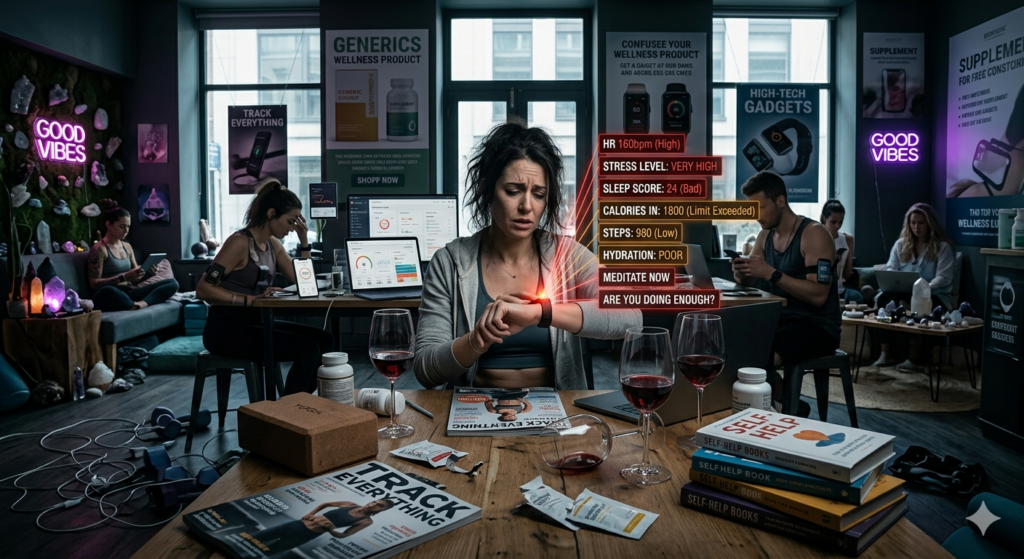
Somewhere in the last decade, “being healthy” got upgraded to “being optimised,” and nobody asked whether we consented. It is no longer enough to sleep. You must achieve sleep, score it out of a hundred, and feel a flicker of shame when your deep sleep is down on last night.
We have nothing against data. We love a good stat. A wearable can be genuinely useful, particularly if you are training for something or keeping an eye on a health condition, where spotting a pattern early actually matters. The problem is not the watch. The problem is what the watch has been allowed to become: a tiny wrist-mounted authority figure, tutting at you before you have even had your coffee.
Wellness, or a very expensive purity culture?
Here is the bit that nags at us. When obsessiveness attaches itself to gambling, we call it a problem. When it circles food, we call it a problem. When it attaches itself to “wellness,” everyone nods along approvingly, because surely caring this much about your health can only be a good thing.
Except it has started to look an awful lot like a purity culture. Clean eating. Clean products. Clean living. A moral hierarchy in which the optimised among us are good, and the rest of us, with our high street moisturiser and our birth control and our occasional glass of wine, are letting the side down. Physical purity repackaged as moral purity, now with a subscription fee.
It is also, let us be honest, deeply exclusive. An ordinary walk is no longer enough. It has to be a walk in the correct heart rate zone, which requires the correct device, which costs money a great many people simply do not have. The same goes for the protein targets, the supplements and the gadgets that promise to make you twenty years younger. Wellness has become something you buy, and then feel like a failure for not buying enough of.
Tell me you’re a man without telling me you’re a man
There is also a gendered edge to all of this. The notion that one slightly off day is a catastrophe worth a viral post is, frankly, a very particular worldview. A great many of us spend a solid chunk of every month being quietly flattened by our own hormones and somehow still file the work, feed the children and keep the dogs alive. We are not optimised. We are coping, which is a different and considerably more impressive skill.
There is a political edge too. The relentless focus on personal responsibility, on fixing yourself one tracked metric at a time, is a very convenient way to avoid talking about anything bigger. It is easier to tell someone they are lazy for not hitting ten thousand steps than to mention food deserts, food banks, or the fact that some people are working three jobs and do not have a spare ninety minutes to spend in nature being mindful.
You’re allowed to just live
None of this is an argument against looking after yourself. Sleep is good. Moving more is good. Vegetables, broadly, are good (we’re not entirely sold on beetroot). The argument is against the creeping belief that your worth is a number, that a bad week is a moral failing, and that the entire point of being alive is to perform at peak capacity at all times like a slightly damp Olympian.
You do not exist to be optimised. You are allowed a glass of wine, a terrible night’s sleep, and a day whose single achievement was that everyone got fed. You survived. The dogs are alive. That, on most days, will absolutely do.
This is the kind of thing we get into every week. Hear the full conversation on the latest episode of Friday I’m In Bed, wherever you get your podcasts.

Leave a Reply